2-3-4 Trees
Definition
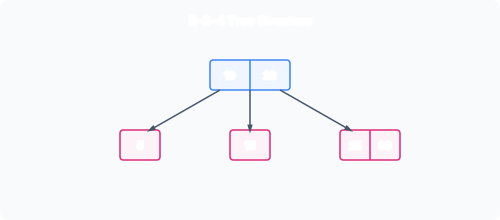
A 2-3-4 tree is a B-tree with minimum degree . Every internal node (except possibly the root) has 2, 3, or 4 children, holding 1, 2, or 3 keys respectively. Leaves are keyless and all at the same depth.
The name derives from the number of children: a 2-node has 1 key and 2 children; a 3-node has 2 keys and 3 children; a 4-node has 3 keys and 4 children.
Why Study 2-3-4 Trees?
All B-tree properties hold: minimum key per non-root node, maximum keys per node. The height is , so all operations are .
2-3-4 trees are the conceptual bridge to red-black trees. Every 2-3-4 tree can be mapped to a red-black tree and vice versa (see “Equivalence of Red-Black and 2-3-4 Trees”). Understanding 2-3-4 operations provides intuition for red-black tree rebalancing.
Insertion
Insertion into a 2-3-4 tree follows the B-tree pattern with :
- Walk down from the root to find the appropriate leaf position.
- If the destination leaf has room (1 or 2 keys), insert directly.
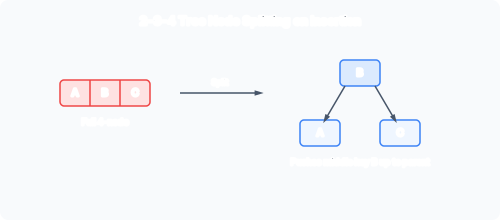
- If the destination leaf is a 4-node (3 keys, full), split it: the middle key (the median) is promoted to the parent, and the remaining keys form two 2-nodes as children of the promoted key.
Splitting can cascade upward. When the root itself is a 4-node and splits, a new root is created, increasing the tree height by 1 while maintaining perfect balance.
Example: Inserting into a 2-3-4 Tree
Starting with a root containing [D,G] (a 3-node). Insert A:
A < D, go left. The left child is a leaf. InsertAthere: the leaf becomes[A,B](ifBwas there) or just[A].
Insert E into a leaf that already has 3 keys [B,D,E] (a 4-node): split by promoting D to the parent and creating left leaf [B] and right leaf [E].
Deletion
Deletion follows the general B-tree delete algorithm with :
- If the key is in a leaf with keys: simple removal.
- If in an internal node: swap with predecessor (or successor), then delete from leaf.
- If the target leaf is a 2-node (minimum size, key):
- Rotate (redistribute): borrow a key from a sibling that has keys. The sibling’s key moves via the parent; the parent’s separator key moves down.
- Merge: if both siblings are also 2-nodes, merge this node with a sibling by pulling the parent’s separator key down. The merged node has 3 keys (from ). This may leave the parent too small, cascading upward.
The Red-Black Connection
The 2-3-4 tree maps directly to a red-black tree:
- A 2-node (1 key, 2 children) → a single black node.
- A 3-node (2 keys, 3 children) → a black node with one red child.
- A 4-node (3 keys, 4 children) → a black node with two red children.
This mapping is an isomorphism: operations on one structure correspond exactly to operations on the other. The height of a red-black tree is at most twice the height of its corresponding 2-3-4 tree, hence .
Summary
| Property | 2-3-4 Tree |
|---|---|
| Type | B-tree with |
| Children per node | 2, 3, or 4 |
| Keys per node | 1, 2, or 3 |
| Height | |
| Insert | Split 4-nodes on overflow |
| Delete | Rotate or merge 2-nodes |
| Map to red-black | 2-node→black, 3-node→black+red child, 4-node→black+2 red children |