B-Trees
Motivation and Definition
B-trees generalise binary search trees: each node can hold many keys and have many children. They are designed for disk-resident data where following a pointer costs ~2 million CPU cycles. By maximising the branching factor, B-trees minimise tree height and thus disk accesses.
A B-tree of minimum degree (with ) satisfies:
- Internal nodes hold at least keys (except the root, which may have as few as 1).
- Internal nodes hold at most keys.
- A node with keys has exactly children.
- All keyless leaves exist at the same depth (perfect height balance).
- Keys partition the key ranges of children: for a node with keys , child contains keys between and (with appropriate adjustments at the ends).
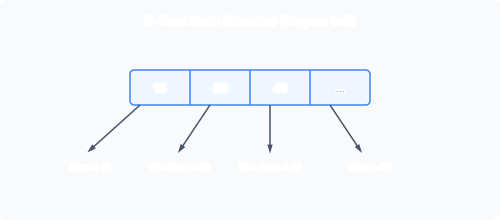
Example: B-tree<2> (t=2). Internal nodes hold 1—3 keys and have 2—4 children. This is also known as a 2-3-4 tree (see next note).
Height Bound
The minimum number of keys at each level (starting from the root) is: 1, , , , and so on. Summing the geometric progression and rearranging:
From which:
Thus the height is . Since can be large (e.g. 100), the tree is very shallow; search, insert, and delete all examine nodes.
Pointer Discipline
Only one pointer to a B-tree is permitted: the root pointer. Internal node pointers must not be stored externally, because restructuring operations (splits, merges) move keys between nodes. A stale pointer could reference a node that no longer contains the expected key.
Search
BT-Search descends from the root. At each internal node, scan the keys (or use binary search since is constant with respect to ) to find the first key the search key. If found, return the payload. If not found at a leaf level (where children are keyless leaves), return NIL. Cost: .
Insert
The naive approach: walk down to the bottom level of internal nodes, insert into the leaf node. If the node overflows (reaches keys), split it around its median into two nodes of keys each, and promote the median to the parent. If the parent is full, splitting cascades upward. If the root splits, a new root is created: the tree grows taller at the top, preserving perfect height balance.
Improved insert: preemptively split any full node encountered on the way down. This guarantees the parent is never full when a split promotion arrives, avoiding upward cascading. It also avoids revisiting nodes already read from disk.
Delete
More complex. Key cases:
- If the key is in a leaf node and the node has keys: simply remove it.
- If the key is in an internal node: swap with predecessor (or successor), which must be in a leaf; then delete from the leaf.
- If the leaf has only keys (minimum): either redistribute (borrow a key from a sibling via the parent), or merge with a sibling (combine keys into one node by “stealing” the separator from the parent). Merging may cascade upward if the parent becomes too small.
- If the root’s last key is merged away, the root is replaced by its merged child: the tree becomes shorter.
Summary
| Property | Value |
|---|---|
| Min keys per node (non-root) | |
| Max keys per node | |
| Children per node | (for keys) |
| Height | |
| Search | |
| Insert | , top-down splitting |
| Delete | , redistribute or merge |
| Key invariance | All leaves at same depth |