Red-Black Trees
Motivation
A standard BST degenerates to height when keys are inserted in sorted order. Red-black trees (RBTs) are binary search trees that maintain approximate balance through an extra colour attribute per node, guaranteeing worst-case height with simple insertion and deletion algorithms.
They generalise 2-3-4 trees into binary form: the structural logic of a multi-way tree is encoded in node colours rather than variable child counts.
The Five Red-Black Properties
A valid red-black tree satisfies:
- Every node is either red or black.
- The root is black.
- The leaves (NIL sentinels) are black and contain no keys.
- Both children of a red node are black (no two consecutive red nodes on any path).
- For each node, all simple paths to descendant leaves contain the same number of black nodes (the black-height is balanced).
Properties 4 and 5 are the crucial ones: Property 4 limits how unbalanced paths can be (you cannot have long chains of nodes), and Property 5 forces uniform black-node depth across all paths.
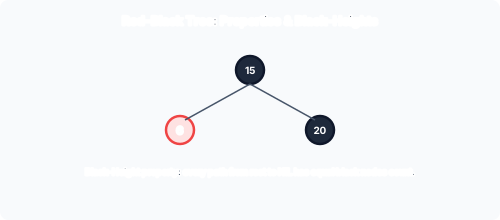
Black-Height
The black-height bh(x) of a node x is the number of black nodes on any path from x (excluding x itself) to a leaf. By Property 5, all such paths have the same count.
Example: in a tree with root=black, two black children, and red grandchildren, the root’s black-height is 2. The leaves (NIL) have black-height 0.
Height Bound
Lemma: A red-black tree with internal (non-leaf) nodes has height .
Proof sketch: For any node , the subtree rooted at has at least internal nodes (minimum when all nodes are black, forming a complete binary tree down to black-height depth). The root’s black-height is at least (by Property 4, at most half the nodes on any path can be red). Thus:
This guarantees worst-case height, hence search, insert, and delete.
Example: Insertion into a RBT
Insert keys [N, D, A] into an initially empty red-black tree:
- Insert
Nas the root (black, by Property 2). - Insert
D<N: add as left child, coloured red. No violation (parent is black). - Insert
A<D<N: add as left child ofD, coloured red. Violation!A(red) has red parentD.
The fix depends on the colour of the uncle (the parent’s sibling): D’s sibling is NIL (black leaf). Since the uncle is black, a rotation at N (right-rotate) and recolouring restores balance. Result: D becomes black root, A and N are red children.
Connection to 2-3-4 Trees
The red-black properties are an Oulipo-style characterisation: they describe valid trees without mentioning 2-3-4 trees. But the underlying reason they work is the isomorphism with 2-3-4 trees:
- A black node anchors its 2-3-4 node.
- Red nodes are “glued” to their black parent, representing extra keys in the same 2-3-4 node.
- The black-height equals the 2-3-4 tree height.
This provides both intuition and correctness: RBT insert/delete correctness follows from 2-3-4 tree correctness, since each operation translates.
Summary
| Property | Requirement |
|---|---|
| 1 | Every node red or black |
| 2 | Root is black |
| 3 | Leaves (NIL) are black |
| 4 | Red node → black children |
| 5 | All paths have same black count |
| Height bound | |
| Search/Insert/Delete | worst case |
| Isomorphic to | 2-3-4 tree (B-tree with ) |