Heaps' Law
The Law
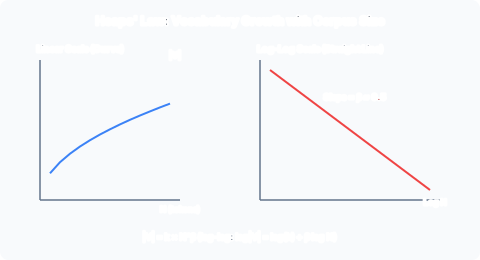
As a corpus grows, its vocabulary keeps growing, but with diminishing returns. No matter how much text you collect, you will always encounter new word types.
- : vocabulary size (number of unique types)
- : total number of tokens in the corpus
- : exponent, typically 0.4-0.6
- : language-dependent constant, typically 30-100
Log-Log Estimation
Taking logs:
Plot against . The result is a straight line:
- Slope =
- Y-intercept =
Why Growth Diminishes
When only 100 tokens have been seen, each new token is likely to be a new type. After 10,000 tokens, most new tokens are repeats of known words. After 1 million tokens, genuinely new types are rare. Yet mathematically, never plateaus: it grows as , which is unbounded (albeit slowly).
With : doubling increases by a factor of . Quadrupling doubles .
Heaps’ Law and Zipf’s Law: The Connection
Zipf’s Law explains the shape of the frequency distribution (many rare words). Heaps’ Law explains the growth of vocabulary with corpus size (unbounded new types). Together they tell a single story: the tail of rare words is not only long but also inexhaustible. Collecting more data reduces but never eliminates the problem of unseen words.
Consequence for Classification
Smoothing is a mathematical necessity, not a pragmatic convenience. Heaps’ Law guarantees that:
- Any finite training corpus will have an incomplete vocabulary.
- New text will contain types never seen in training, regardless of training corpus size.
- Without smoothing, for unseen words, collapsing all class probabilities to zero.
This is the theoretical justification for Laplace (add-one) smoothing: it assigns non-zero probability to the infinite set of possible but unseen word types by reserving a portion of the probability mass.
Summary
| Aspect | Detail |
|---|---|
| Heaps’ Law | |
| range | 0.4-0.6 |
| range | 30-100 |
| Estimation | Least-squares on log-log plot |
| Consequence | Vocabulary is effectively infinite; smoothing is mandatory |
Past paper questions: y2024p3q7 (feature engineering)