The Confusion Matrix and Evaluation Metrics
The 2×2 Confusion Matrix
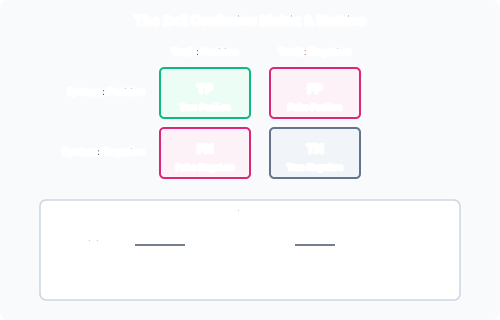
For binary classification, every prediction falls into one of four cells:
| Truth: Positive | Truth: Negative | |
|---|---|---|
| System says: Positive | TP (True Positive) | FP (False Positive) |
| System says: Negative | FN (False Negative) | TN (True Negative) |
- TP: correctly identified positives (bullies caught)
- FP: false alarms (innocent messages flagged)
- FN: missed positives (bullies that slipped through)
- TN: correctly identified negatives (innocent messages passed)
Accuracy
Accuracy is misleading when classes are imbalanced. A classifier that labels every message “OK” on a dataset with 95% OK messages achieves 95% accuracy, yet detects zero bullying. Always check class distribution before trusting accuracy.
Precision
Of all messages the system claimed were bullying, what fraction truly were? High precision means when the system flags something, you can trust it.
Prioritise high precision when: medical treatment decisions, legal evidence flagging, any domain where false alarms carry high cost.
Recall
Of all actual bullying messages, what fraction did the system find? High recall means few bullies are missed.
Prioritise high recall when: disease screening, spam detection, brand-attack detection, any domain where missing a positive is worse than a false alarm.
F1 Score
The harmonic mean of precision and recall. F1 penalises extreme imbalance: if precision = 0.9 and recall = 0.1, F1 = 0.18 (not 0.5). This makes F1 more honest than the arithmetic mean.
Prioritise high F1 when: most NLP classification tasks, balanced trade-off needed.
Worked Example
A bullying-filter classifier is evaluated on 1000 messages, of which 100 are truly bullying:
| Truth: Bullying | Truth: OK | |
|---|---|---|
| System says: Bullying | TP = 80 | FP = 40 |
| System says: OK | FN = 20 | TN = 860 |
- Accuracy = (80 + 860) / 1000 = 0.94 (94%)
- Precision = 80 / (80 + 40) = 80/120 = 0.667
- Recall = 80 / (80 + 20) = 80/100 = 0.80
- F1 = 2 × (0.667 × 0.80) / (0.667 + 0.80) = 2 × 0.534 / 1.467 = 0.728
Accuracy looks excellent at 94%, but that is driven by the 860 TNs. Precision and recall reveal that one third of flagged messages are false alarms, and one fifth of bullies are missed.
Note: precision and recall are always defined with respect to a specific class (here, bullying). There is no such thing as “overall precision” without specifying the class of interest.
Summary
| Metric | Formula | Use |
|---|---|---|
| Accuracy | (TP+TN)/Total | Balanced classes only |
| Precision | TP/(TP+FP) | When false alarms are costly |
| Recall | TP/(TP+FN) | When missing positives is costly |
| F1 | 2PR/(P+R) | Balanced trade-off |
Past paper questions: y2021p3q9(b)