Fitts' Law and Hick's Law
Fitts’ Law
Fitts’ Law predicts the time required to point at a target of a given size at a given distance:
Where:
- MT is movement time.
- D is the distance from the starting point to the centre of the target.
- W is the width of the target measured along the axis of motion.
- and are empirically fitted constants (device- and user-dependent).
- is the Index of Difficulty (ID) — measured in bits.
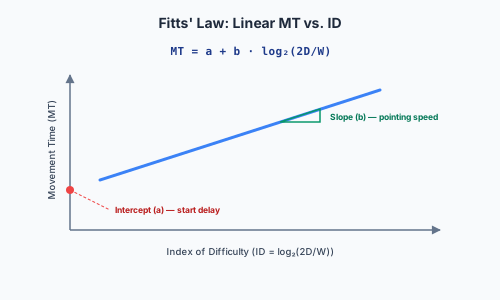
Core insight: pointing time increases with distance and decreases with target width. Make frequently-used or high-value targets large and close to the current cursor or finger position.
Semantic Pointing
Semantic pointing exploits Fitts’ Law by modifying the effective mapping between input motion and screen motion. More likely targets are given greater effective width and reduced effective distance (independent of their visible size), speeding up pointing without changing the visual layout. The cursor slows down over probable targets and speeds up across empty space — an algorithmic, not visual, application of Fitts’ Law.
Design Implications
- Put frequently-used controls at screen edges — the edge acts as an infinite target in one dimension (you cannot overshoot).
- On mobile, place key actions within the thumb’s natural reach zone (the lower portion of the screen).
- Avoid tiny, closely-spaced touch targets — the “fat-finger problem”: an adult fingertip is roughly 10–14 mm wide, so targets smaller than this are physically difficult to hit accurately.
Hick’s Law (Hick–Hyman Law)
Hick’s Law predicts the time required to make a decision among equally likely alternatives:
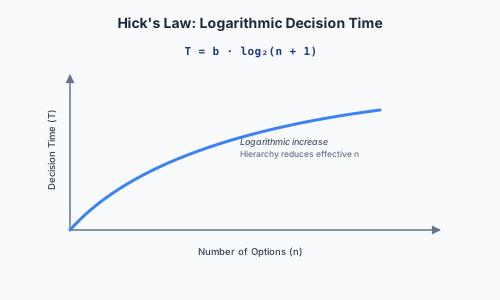
Core insight: decision time increases (logarithmically) with the number of choices presented simultaneously. Do not overwhelm users with too many options — large flat menus slow decision-making.
Design mitigation: grouping or hierarchy (chunking) reduces the effective at each decision point. Rather than presenting 12 menu items in one flat list (), group them into 3 categories of 4 ( at the first level, then at the second). Because is concave, , so the hierarchical structure is predicted to be faster — provided the user understands the grouping.
Worked Example: Comparing Two Layouts
Given Layout A (a single flat list of 6 menu options spread across the screen) vs Layout B (the same 6 options grouped into 2 categories of 3, in a tighter cluster):
Hick’s Law analysis: Layout B requires an initial choice between 2 categories (), then 3 items () — two smaller decisions rather than one decision. Predicted decision time is lower for Layout B, provided the grouping matches the user’s mental categorisation.
Fitts’ Law analysis: Layout B’s tighter clustering reduces average distance between commonly-used controls, further reducing predicted movement time — assuming target widths are not reduced disproportionately by the tighter packing.
Combined prediction: Layout B is faster for both decision-making and pointing, provided the grouping is intuitive. If the grouping is arbitrary (does not match the user’s mental model), the extra navigation step could increase search time and errors — a limitation neither law captures, because neither models learnability or confusion.
Expected Learning
- State Fitts’ Law and Hick’s Law with their formulae.
- Explain why edges and corners are fast targets (infinite effective width).
- Given two candidate layouts, compare them using both laws, stating the assumptions and limitations of the prediction.
- Explain why grouping reduces effective and how the concave function makes hierarchical menus faster than flat ones.
- Distinguish what these laws do predict (expert motor and decision time) from what they do not (learnability, errors, satisfaction).
Past Paper Questions
Fitts’ and Hick’s Laws appear in: 2018 Q6(c) (layout comparison using both laws). The mathematical predictions are straightforward — the marks come from applying the laws correctly to the specific numbers in the scenario and acknowledging their limitations.