Half Adder and Full Adder
Addition as a logic problem
Adding two binary digits produces a sum and a carry. This is a combinational logic function: the inputs are the two operand bits, the outputs are the sum and carry bits. There are two standard building blocks.
Half adder
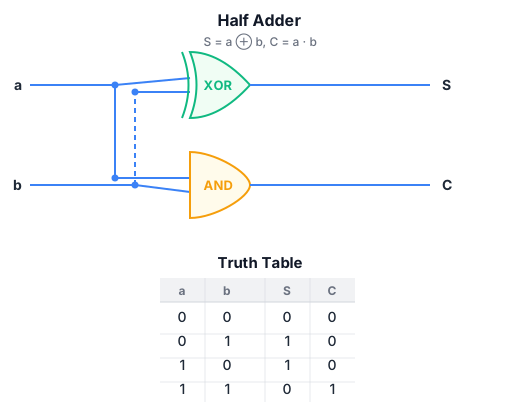
A half adder adds two single-bit inputs a and b, producing a sum bit s and a carry-out bit c. It does not accept a carry-in from a previous column.
| a | b | s (sum) | c (carry) |
|---|---|---|---|
| 0 | 0 | 0 | 0 |
| 0 | 1 | 1 | 0 |
| 1 | 0 | 1 | 0 |
| 1 | 1 | 0 | 1 |
From the truth table:
The sum is the XOR of the inputs; the carry is their AND. The gate-level implementation requires one XOR gate and one AND gate.
Full adder
A full adder adds three bits: two operand bits a and b, plus a carry-in cin from the previous (less significant) column. It produces a sum s and carry-out cout.
| a | b | cin | s | cout |
|---|---|---|---|---|
| 0 | 0 | 0 | 0 | 0 |
| 0 | 0 | 1 | 1 | 0 |
| 0 | 1 | 0 | 1 | 0 |
| 0 | 1 | 1 | 0 | 1 |
| 1 | 0 | 0 | 1 | 0 |
| 1 | 0 | 1 | 0 | 1 |
| 1 | 1 | 0 | 0 | 1 |
| 1 | 1 | 1 | 1 | 1 |
The sum is the XOR of all three inputs:
since XOR is associative. The carry-out is a majority function: it is 1 when at least two of the three inputs are 1.
An equivalent and more hardware-efficient expression:
This formulation is useful because a ⊕ b is already computed for the sum, so only one additional AND and one OR are needed.
Building a full adder from half adders
A full adder can be constructed from two half adders and an OR gate:
- First half adder: computes
s1 = a ⊕ bandc1 = a · b. - Second half adder: takes
s1andcin, computess = s1 ⊕ cin = a ⊕ b ⊕ cinandc2 = s1 · cin = (a ⊕ b) · cin. - OR gate:
cout = c1 + c2 = a · b + (a ⊕ b) · cin.
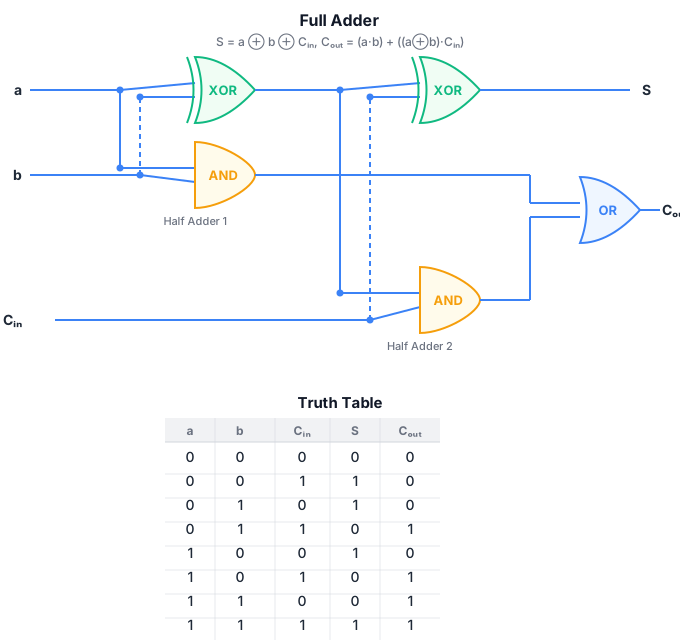
This decomposition reveals why the expression a · b + (a ⊕ b) · cin is natural: c1 = a · b is the carry generated within this column, and c2 = (a ⊕ b) · cin is the carry propagated through from the previous column. These are exactly the generate and propagate signals used in carry lookahead adders.
Gate count
A full adder built from two half adders plus OR requires: 2 XOR, 3 AND, 1 OR (5 gates total, though XOR itself typically requires multiple primitive gates). For an n-bit ripple carry adder, the total gate count is proportional to n, and the worst-case delay is also proportional to n, limited by the carry chain.