Part IA Easter Term
Password vs Public-Key Authentication
This comparison is directly assessed in the 2025 Tripos Paper 2 Q5(b), a 14-mark part. You must discuss both how login works and how cross-server post authentication works — the question asks for both.
How Password Authentication Works
- The user registers with a username and password.
- The server hashes the password with a salt (a random per-user value) using a slow, computationally-expensive hash function (bcrypt, scrypt, Argon2) and stores the salt and the hash. The plaintext password is never stored.
- To log in, the user submits their credentials over TLS (encrypted transport). The server hashes the provided password with the stored salt and compares the result to the stored hash.
- On match, the server issues a session token (typically an opaque random string or a signed JWT) that the client includes in subsequent requests.
How Public-Key Authentication Could Work
Login to the Home Server (Challenge-Response)
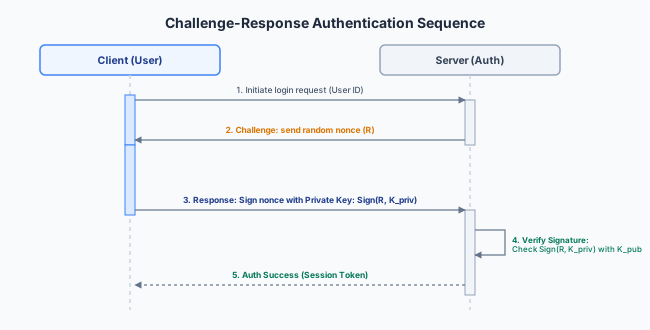
- The user generates a key pair locally. The public key is registered with their home server. The private key never leaves the user’s device.
- To log in, the server sends a random challenge (a nonce — a large random number used once).
- The client signs the challenge with the private key. The signature proves possession of the private key without revealing it.
- The server verifies the signature against the stored public key. On success, it issues a session token.
- Crucially, no secret (password or private key) ever crosses the network. A network observer, or even a compromised server, cannot learn the private key.
Cross-Server Post Authentication
- When a user creates a post, the post payload is digitally signed by the author’s private key.
- When the post is federated to another server, that server fetches the author’s public key from the author’s home server (analogous to fetching a TLS certificate).
- The receiving server verifies the signature against the public key. This cryptographically proves: “this post was authored by the holder of the private key corresponding to this public key, and it has not been tampered with in transit.”
- Under password authentication, cross-server authenticity has no equivalent mechanism. Server B must simply trust Server A’s word that a post is genuine — a Spoofing vulnerability (STRIDE).
Comparison Table
| Aspect | Password | Public-Key |
|---|---|---|
| Secret transmitted over the network? | Yes (over TLS) — vulnerable if server or TLS is compromised; vulnerable to phishing (user types password into a fake login page) | No — only a signed challenge is sent. Resistant to phishing and server-side credential database breaches. |
| Server-side breach impact | Stolen hash database can be subjected to offline brute-force and dictionary attacks (especially if the hash function is weak or unsalted) | Only public keys are stored on the server. A breach discloses no secret — an attacker learns who the users are but cannot impersonate them. |
| Usability | Familiar to all users. Easy recovery: “forgot password” → email reset link. | Unfamiliar to most users. Key management is hard: no simple “forgot key” recovery path. Losing the private key with no backup can mean permanent loss of account control. |
| Cross-server trust (federated / decentralised setting) | Each server independently manages passwords; a compromised server cannot forge other servers’ users anyway (password hash comparison only works locally), but there is no way for Server B to verify that a post attributed to Server A’s user is genuine — it must trust Server A’s claim. | A signature is independently, cryptographically verifiable by any receiving server. Directly mitigates Spoofing and Repudiation for federated content. |
| Revocation | Change password instantly via email reset. | Revoking a compromised key requires a distribution mechanism (e.g. a Certificate Revocation List) so that all servers know the old key is invalid. |
| Key / credential loss | Password reset via secondary channel (email) is straightforward and widely understood. | Losing the private key — if the user did not back it up — can mean permanent loss of account control. No recovery mechanism equivalent to “forgot password.” |
A Balanced Recommendation (Hybrid)
A strong exam answer proposes a hybrid approach:
- Login: keep passwords (with two-factor authentication) for login usability. Login is a human-facing, low-frequency operation where usability and recoverability dominate.
- Post authentication: adopt public-key signing for every federated post. Post authentication is a machine-to-machine, high-frequency operation where cryptographic verifiability is essential, and the human usability concern (“I lost my signing key”) does not apply moment-to-moment — it only matters at key-creation and key-revocation time.
This hybrid isolates the usability burden of key management to infrequent operations (key generation, device enrolment, key rotation) while gaining the cryptographic verifiability that a decentralised trust model demands.
Expected Learning
- Describe the challenge-response mechanism for public-key login, explaining why the private key never crosses the network.
- Describe how signed posts enable cross-server authentication in a decentralised system.
- Compare password and public-key authentication across: secret transmission, server-breach impact, usability, cross-server trust, revocation, and key-loss recovery.
- Propose and justify a hybrid approach tailored to the specific needs of login (usability) and federation (cryptographic verifiability).
Past Paper Questions
The 2025 Tripos Paper 2 Q5(b) is the definitive source — a 14-mark part. The model answer is reproduced in full in the Examinable Material section.