Part IA Michaelmas Term
OOP Syllabus Checklist
A comprehensive checklist of everything examinable in the Part IA Object-Oriented Programming paper.
Java Language Basics
- Primitive types (
int,double,boolean,char,byte,short,long,float) - Reference types (everything else — objects, arrays, strings)
- Variable declaration and initialisation
- Arrays (declaration, initialisation,
length,for-each loop) - Method overloading (same name, different parameter lists — NOT return type)
- Classes and objects (class as blueprint,
newfor instantiation) - Constructors (default, parameterised,
this(), no-arg constructor lost if any constructor is defined) -
staticmembers (class-level, not instance-level —staticfields shared across all instances,staticmethods cannot accessthis) - Access modifiers (
public,protected, default/package-private,private) - Encapsulation (private fields + public getters/setters)
- Immutability (
finalfields, no setters, defensive copying of mutable fields, classfinalor constructor private)
Tripos traps
staticmethods cannot be overridden — they can only be hidden/shadowed. Resolution is at compile time based on the reference type, not the object type.- Method overloading is compile-time; method overriding is runtime.
- An array of primitives contains values; an array of objects contains references.
Memory Model
- Stack vs heap (stack: local variables, method frames, primitive values, references; heap: objects, arrays)
- References vs pointers (references are abstract handles — no arithmetic, no direct address manipulation)
- Pass-by-value in Java (the value is passed — for primitives, the value itself; for references, the reference value is copied, so the method cannot change which object the caller’s variable points to, but can mutate the object)
- Garbage collection (automatic, unreachable objects are collected;
System.gc()is a hint only)
Tripos traps
- Java is always pass-by-value. For objects, the reference is passed by value. This means you cannot make a method swap two object references, but you can mutate the object’s state.
Inheritance
-
extendskeyword (single inheritance of implementation) -
super(call superclass constructor — must be first line; access superclass methods/fields) - Method overriding (same name, same parameters, same return type or covariant —
@Overrideannotation) - Overriding vs shadowing (methods override by instance type; fields and static methods shadow by reference type)
-
abstractclasses (cannot be instantiated; may have abstract methods; may have concrete methods) -
abstractmethods (no body; must be overridden in concrete subclass) -
finalclasses (cannot be subclassed) -
finalmethods (cannot be overridden) - Inheritance of implementation vs inheritance of interface
- Interfaces (
implements; all methods implicitlypublic abstractbefore Java 8) - Single vs multiple inheritance (Java: single inheritance of implementation, multiple inheritance of interface)
- The diamond problem (two paths to the same base — Java resolves with single implementation inheritance + default methods with explicit override required)
-
defaultmethods in interfaces (Java 8+; provide method body; can be overridden; resolve ambiguity withInterface.super.method())
Tripos traps
- Fields are never overridden — they are shadowed.
super.fieldaccesses the superclass field;this.fieldaccesses the subclass field. - A
staticmethod with the same signature in a subclass hides the superclass version. Which one runs depends on the reference type, not the object type.
Polymorphism
- Static (compile-time) polymorphism: method overloading
- Dynamic (runtime) polymorphism: method overriding, dynamic dispatch
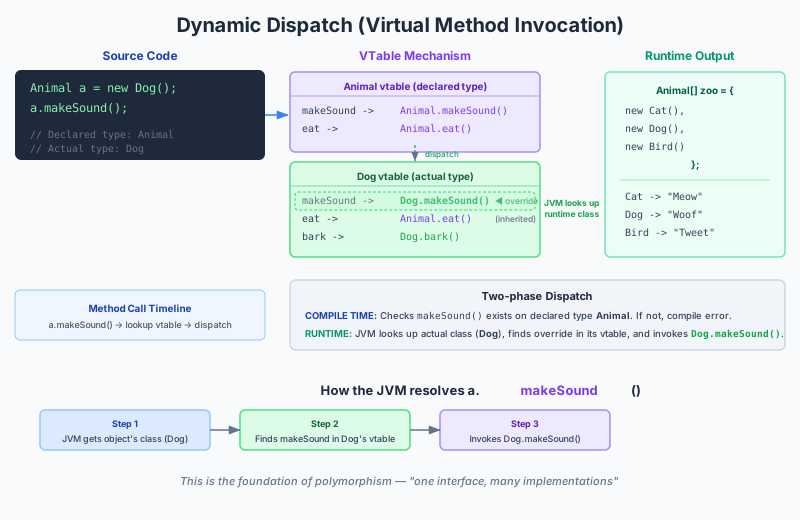
- Dynamic dispatch mechanism (vtable: each object has a reference to its class’s vtable; the JVM looks up the actual method to call at runtime based on the object’s concrete class)
- Upcasting (implicit — treating a subclass object as superclass type)
- Downcasting (explicit —
(Subclass) superRef; may throwClassCastException) -
instanceofcheck before downcasting
Tripos traps
- Dynamic dispatch applies only to instance methods, not to fields, static methods, or private methods.
Animal a = new Dog(); a.makeSound();— the runtime typeDogdetermines whichmakeSound()runs. Buta.name(ifnameis a field) uses the compile-time typeAnimal.
OOP Principles
- Single Responsibility Principle (SRP): A class should have exactly one reason to change. Each class does one well-defined thing.
- Open-Closed Principle (OCP): Classes should be open for extension but closed for modification. Add new behaviour by adding new code, not by changing existing code.
- Liskov Substitution Principle (LSP): Subtypes must be substitutable for their base types without altering correctness. A subclass should not strengthen preconditions or weaken postconditions.
- Cohesion: how closely related the responsibilities of a class are. High cohesion (good) — all methods and fields serve a single, well-defined purpose. Low cohesion (bad) — a class does many unrelated things.
- Coupling: the degree of interdependence between classes. Loose/low coupling (good) — classes know little about each other, interact through interfaces. High/tight coupling (bad) — changing one class forces changes in many others.
Tripos traps
- LSP violations often come from strengthening preconditions (e.g., a subclass requires a parameter that the superclass does not) or weakening postconditions.
- SRP violations often come from mixing business logic with persistence, or mixing computation with display.
Object Lifecycle
- Object creation:
newallocates memory on the heap, calls the constructor chain (subclass → superclass all the way toObject) - Garbage collection: automatic; objects become eligible when no live references point to them
- Mark-and-sweep algorithm: (1) Mark phase — trace all reachable objects from root set (stack, static fields). (2) Sweep phase — reclaim unmarked objects.
-
finalize()— deprecated; called by GC before object is reclaimed; unpredictable timing; not for resource cleanup - Shallow copy vs deep copy (shallow: copy references, not objects; deep: recursively copy referenced objects)
-
clone()—Object.clone()does shallow copy; must implementCloneable; overrideclone()for deep copy - Copy constructors —
public MyClass(MyClass other)— preferred overclone()
Tripos traps
finalize()is deprecated in Java 9+ and should not be relied upon. Usetry-with-resourcesfor resource cleanup.clone()is fragile — use a copy constructor instead.
Collections and Comparisons
- Collection interfaces:
List(ordered, allows duplicates),Set(no duplicates),Map(key-value pairs),Queue(FIFO) - Common implementations:
ArrayList(dynamic array, random access, insertion/removal from middle),LinkedList(doubly-linked, insertion/removal at ends, random access),HashSet/HashMap( average operations, unordered),TreeSet/TreeMap(, sorted) -
==vs.equals()(==compares references/identity;.equals()compares logical equality — must override for custom classes) -
hashCodecontract: ifa.equals(b), thena.hashCode() == b.hashCode(). The converse is not required. Both must be overridden together. -
Comparable<T>—int compareTo(T other)— defines natural ordering (one ordering per class) -
Comparator<T>—int compare(T a, T b)— defines external ordering (multiple comparators per class)
Tripos traps
- If you override
equals()but nothashCode(),HashSetandHashMapwill misbehave — two equal objects can end up in different buckets. Comparableis implemented by the class being compared;Comparatoris a separate class that compares other objects.
Generics
- Type parameters:
class Box<T> { T value; } - Type erasure: at runtime, type parameters are erased to their bounds (e.g.,
<T>→Object,<T extends Number>→Number). The JVM never sees the type parameter. - Why erasure? Backward compatibility — Java 5 generics had to work with pre-generics bytecode.
- Covariance:
Integer[]is a subtype ofNumber[](arrays are covariant — a runtime type check prevents storing the wrong type). - Invariance:
List<Integer>is NOT a subtype ofList<Number>(generics are invariant — prevents the array covariance problem at the type level). - Wildcards:
?— unbounded wildcard; read-only (exceptnull)? extends T— upper-bounded; producer (you can readTfrom it, cannot write)? super T— lower-bounded; consumer (you can writeTto it, can only readObject)
- PECS: Producer Extends, Consumer Super
- Type bounds:
<T extends Comparable<T>>— T must implementComparable<T>
Tripos traps
List<String>andList<Integer>have the same runtime type (List). Overloading on different generic parameters does not work because they erase to the same signature.- Generic type information is not available at runtime. You cannot do
if (obj instanceof List<String>).
Exceptions
- Exception hierarchy:
Throwable→Error(unrecoverable —OutOfMemoryError,StackOverflowError) andException→RuntimeException(unchecked —NullPointerException,IndexOutOfBoundsException) and checked exceptions (IOException,SQLException) - Checked vs unchecked: checked exceptions must be caught or declared in
throwsclause; unchecked exceptions do not need to be -
try-catch-finally:finallyalways executes (even afterreturn, even after exception) — except forSystem.exit()or JVM crash -
try-with-resources:try (Resource r = new Resource()) { ... }— automatically callsclose()when the block exits; resource must implementAutoCloseable - Exception guidelines: catch specific exceptions, not
Exception; never swallow exceptions silently; exceptions are for exceptional conditions, not flow control - Assertions:
assert condition : "message";— disabled at runtime by default (enable with-ea); for debugging invariants, not for production error handling

Tripos traps
- Using exceptions for control flow (e.g., catching
ClassCastExceptioninstead of usinginstanceof) is an anti-pattern. Exceptions are for exceptional situations. - A
finallyblock that throws an exception will mask any exception thrown in thetryblock.
Design Patterns
- Composite: Treat one object and group of objects uniformly through a shared interface
- Decorator: Add responsibilities to individual objects dynamically by wrapping
- State: Object changes behaviour when its internal state changes (delegates to state objects)
- Strategy: Interchangeable algorithms selected externally by the client
- Singleton: Exactly one instance with global access (private constructor + static factory)
- Observer: Notify many dependents automatically when subject’s state changes
-
Optional<T>: Container for possibly-absent value; avoids null; designed for method return types

Tripos traps
- State and Strategy are structurally identical — distinguish by intent (internal state change vs external algorithm choice).
- Always tie patterns to OCP or another principle. A pattern without justification is only half an answer.
Lambdas and Streams
- Lambda expressions:
(params) -> expressionor(params) -> { statements; } - Functional interfaces: interfaces with exactly one abstract method (SAM type)
-
@FunctionalInterfaceannotation - Built-in functional interfaces:
Function<T,R>,Predicate<T>,Consumer<T>,Supplier<T>,BiFunction<T,U,R>,UnaryOperator<T>,BinaryOperator<T> - Method references:
Class::staticMethod,instance::method,Class::instanceMethod,Class::new - External vs internal iteration
- Streams: lazy, single-use pipelines (not data structures)
- Intermediate operations:
filter,map,flatMap,sorted,distinct,limit,skip,peek - Terminal operations:
forEach,collect,reduce,count,anyMatch/allMatch/noneMatch,findFirst/findAny - Laziness: nothing runs until a terminal operation
- Short-circuiting:
limit,findFirst,anyMatch - Parallel streams:
parallelStream()for CPU-intensive, stateless, large-dataset operations - Collectors:
toList(),toSet(),toMap(),groupingBy(),joining()

Tripos traps
- An intermediate operation without a terminal operation does nothing.
- Streams are single-use — cannot reuse after a terminal operation.
forEachon a parallel stream does not guarantee order. UseforEachOrdered.
UML
- Class diagrams: class name, fields (name: type), methods (name(params): return)
- Relationships: association (solid line), inheritance/extends (solid line with hollow triangle), implements (dashed line with hollow triangle), aggregation (hollow diamond), composition (filled diamond)
- Visibility:
+public,-private,#protected - Abstract classes and methods in italics

How to use this checklist
For each topic, you should be able to:
- Define the concept in one sentence.
- Write a short code example.
- Identify the common Tripos traps and explain why they happen.
- Connect the concept to at least one design principle (OCP, LSP, SRP, loose coupling, high cohesion).