The Java Collections Framework
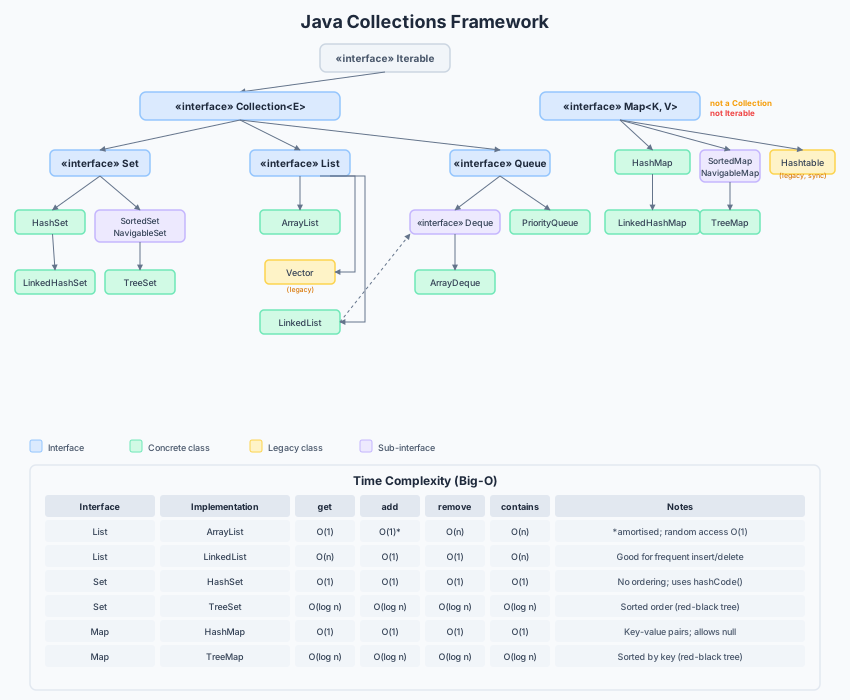
The Two Hierarchies
The Collections Framework is divided into two distinct interface trees:
Collection<E>— the root interface for most collections (groups of elements).Map<K, V>— a separate, parallel hierarchy for key–value mappings.Mapis not aCollection.
The Collection<E> Sub-Interfaces
List<E>
An ordered collection (sequence). Elements have a positional index. Duplicates are allowed. The user controls where each element is inserted.
List<String> names = new ArrayList<>();
names.add("Alice");            // index 0
names.add("Bob");              // index 1
names.add("Alice");            // index 2 — duplicate is fine
String second = names.get(1);  // "Bob"
Set<E>
A collection with no duplicates (as defined by equals()). May or may not be ordered depending on implementation.
Set<String> unique = new HashSet<>();
unique.add("Alice");
unique.add("Bob");
unique.add("Alice");           // ignored — already present
Queue<E>
A collection designed for holding elements prior to processing. Typically FIFO (first-in-first-out) but can also be priority-ordered. Provides insertion, extraction, and inspection operations, each in two forms: one that throws an exception on failure, and one that returns a special value.
Deque<E> (Double-Ended Queue)
Extends Queue<E>. Supports element insertion and removal at both ends. Can be used as a stack (LIFO) or a queue (FIFO).
The Map<K, V> Hierarchy
Maps keys to values. Each key can map to at most one value. No duplicate keys. Replacing a mapping for an existing key overwrites the old value.
Map<String, Integer> scores = new HashMap<>();
scores.put("Alice", 85);
scores.put("Bob", 92);
int aliceScore = scores.get("Alice");  // 85
Common Implementations
| Interface | Implementations | Characteristics |
|---|---|---|
List | ArrayList | Resizable array, random access, mid-list insert |
List | LinkedList | Doubly-linked, insert/remove at known position, random access |
Set | HashSet | Hash table, operations, no ordering |
Set | TreeSet | Red-black tree, operations, sorted order |
Set | LinkedHashSet | Hash table + linked list, insertion order |
Queue / Deque | ArrayDeque | Resizable array, faster than Stack and LinkedList for queue/stack use |
Map | HashMap | Hash table, operations, no ordering |
Map | TreeMap | Red-black tree, operations, sorted keys |
Map | LinkedHashMap | Hash table + linked list, insertion or access order |
Generic Usage and the Diamond Operator
List<String> strings = new ArrayList<>();          // diamond <> infers String
Set<Integer> numbers = new HashSet<>();
Map<String, List<Integer>> nested = new HashMap<>();
The diamond operator (<>) was introduced in Java 7. It avoids repeating type arguments and keeps declarations concise.
The Collections Utility Class
java.util.Collections provides static utility methods that operate on or return collections:
Collections.sort(list);                          // in-place sort (natural order)
Collections.sort(list, comparator);              // in-place sort (custom order)
Collections.binarySearch(list, key);             // binary search (list must be sorted)
Collections.shuffle(list);                       // random permutation
Collections.reverse(list);                       // reverse in-place
Collections.min(collection);                     // minimum element
Collections.max(collection);                     // maximum element
Collections.unmodifiableList(list);              // read-only wrapper
Collections.synchronizedList(list);              // thread-safe wrapper
Collections.frequency(collection, element);      // count occurrences
Programming to Interfaces
List<String> list = new ArrayList<>();
list = new LinkedList<>();  // change implementation, rest of code unchanged
By declaring variables and parameters using the most general interface type that meets your needs, you isolate the rest of the code from implementation details. If you later decide LinkedList is better than ArrayList for your access pattern, you change one line — the constructor call — and all other code continues to work.
This is a direct application of the Dependency Inversion Principle and enables both the Open/Closed Principle and testability with mock implementations.