The Small-World Phenomenon
Definition
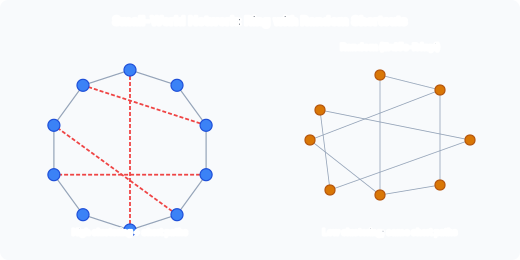
A network exhibits the small-world phenomenon if it simultaneously satisfies both of two conditions:
- Short average path length: (grows logarithmically, not linearly, with the number of nodes ). Adding nodes barely increases the typical distance between pairs.
- High clustering coefficient: (much higher than an equivalent random graph with the same number of nodes and edges).
Both conditions must hold. A random graph has short paths but negligible clustering (, which is tiny). A regular lattice (grid) has high clustering but long paths ( for a 2D grid). A small-world network uniquely has both.
The Key Insight
A few random long-range “shortcut” edges dramatically collapse the average path length while leaving local clustering largely intact. Consider a ring lattice where each node connects to its nearest neighbours. The path length is (linear in ). Adding just a small fraction of randomly rewired edges drops to while preserving most of the local clustering.
This is the Watts-Strogatz model (1998): start with a regular ring lattice, then rewire each edge with probability to a random destination. At , it is a regular lattice (high , high ). At , it is a random graph (low , low ). For , the network is small-world: stays high while drops sharply. This narrow range is where most real-world social networks lie.
Example: Milgram’s Letter Experiment (1967)
Stanley Milgram asked randomly selected participants in Omaha, Nebraska, and Wichita, Kansas, to send a letter to a target person (a stockbroker in Boston, Massachusetts) by forwarding it to acquaintances they knew on a first-name basis. Each participant could only send the letter to someone they knew personally who might be “closer” to the target.
Result: the median number of intermediaries was approximately 6. This originated the phrase “six degrees of separation” and provided the first empirical evidence that social networks have surprisingly short paths: any two people in the United States are connected by a chain of roughly six acquaintances.
Why It Matters
Small-world structure has profound consequences:
- Viral content: a post, meme, or video can reach millions of people through short chains of shares in hours.
- Disease spread: an infectious disease can cross the globe in days, not months, because the social network provides shortcuts between distant regions.
- Innovation diffusion: new ideas, technologies, and practices spread rapidly through professional networks.
- Rumour propagation: false information travels just as efficiently as true information; there is no “truth filter” in the network topology.
Small-World vs. Scale-Free
These are independent properties. A network can be:
- Small-world AND scale-free (most real social networks: Facebook, collaboration networks).
- Small-world but NOT scale-free (Watts-Strogatz ring-lattice model: uniform degree distribution, but short paths + high clustering).
- Scale-free but NOT small-world (if clustering is low, e.g., a pure Barabási-Albert preferential-attachment network without triadic closure).
Do not confuse them. Small-world is about path length and clustering. Scale-free is about the degree distribution .
Summary
| Property | Requirement |
|---|---|
| Average path length | (grows slowly) |
| Clustering coefficient | (much higher than random) |
| Mechanism | A few random long-range shortcut edges |
| Famous example | Milgram’s “six degrees” experiment |
| Model | Watts-Strogatz (rewire ring lattice with small ) |
| Consequence | Rapid spread of information, disease, influence |
| NOT the same as | Scale-free (which describes degree distribution, not path length) |
Past paper questions: y2025p3q8 (clustering-related parts)