The Three Waves of HCI
A Broadening Discipline
Human-Computer Interaction has evolved through three overlapping “waves” (or paradigms). Each wave introduced new theories, methods, and values — not to replace earlier ones, but to broaden the discipline’s toolkit. The waves are cumulative: first-wave methods remain the right choice for first-wave problems; second-wave methods for second-wave problems.
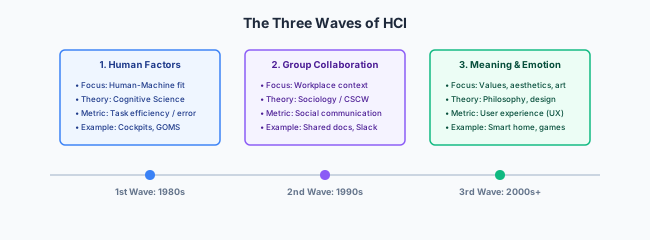
First Wave (1980s): Efficiency and Human Factors
Core theories: Human Factors Engineering, Ergonomics, Cognitive Science.
Key assumptions:
- The “user interface” is a separate module, designed independently of the system’s core functionality.
- The human is an operator performing well-defined, measurable tasks.
- The primary goal is efficiency — speed and accuracy, minimising errors.
- The user’s cognitive processes can be modelled as information processing.
Typical example: a control panel of switches, dials, and lamps. An air-traffic control display.
Key principles: group related information; structure sequences of operation; make important controls large and salient (Fitts’ Law); keep task sequences short (KLM).
Methods: task analysis (HTA), GOMS/KLM, lab-based controlled experiments, Cognitive Walkthrough.
Second Wave (1990s): Context and Socio-Technical Systems
Core theories: Anthropology, Sociology, Work Psychology, Participatory Design.
Key shift: computers are understood as one part of a socio-technical system — not a standalone tool. The context of use (the office, the hospital ward, the factory floor) is inseparable from the design.
Typical example: an open-plan office with paper notes, noticeboards, shared whiteboards, and physical coordination artefacts alongside digital systems. The interaction includes how people coordinate around and through the technology, not just how they operate the GUI.
Key principles: study the context before designing; involve users in the design process (participatory design); the system must fit the existing workflow, not demand the workflow change to fit the system.
Methods: ethnography, contextual inquiry, prototyping, participatory design workshops, focus groups.
Third Wave (2000s onwards): Emotion, Meaning, and Experience
Core theories: Art, Philosophy, Design, Phenomenology.
Key shift: computing escapes the workplace. With the web, smartphones, and ubiquitous computing, systems are used in all aspects of life — and outside the workplace, efficiency is not the priority and usage is discretionary. Users do not have to use your app; they choose to (or not).
New concerns:
- Emotion: how does the system make the user feel? Anxious? Empowered? Delighted?
- Aesthetics: is it beautiful? Does beauty affect perceived usability?
- Meaning: what does this system mean to its users? Does it help them be social, creative, or feel in control?
- Ethics: what are the unintended social consequences of this design?
Typical example: a speculative or critical design artefact (e.g. the “blood-bag radio” — a radio powered by a blood bag, designed to provoke questions about energy consumption). A mindfulness app designed to reduce anxiety.
Methods: experience prototyping, cultural probes, reflective design, aesthetic evaluation, speculative and critical design.
Using the Three Waves in an Exam Answer
When asked to analyse or design for a specific system, identify which wave’s concerns dominate:
- An air-traffic control system is a first-wave problem: safety-critical, efficiency-driven, task-based, expert users. Prioritise task analysis, KLM, and error prevention.
- A hospital ward communication system is a second-wave problem: socio-technical, context-dependent, multiple stakeholder types. Prioritise ethnography, contextual inquiry, and participatory design.
- A mental-health support app is a third-wave problem: emotional, discretionary, meaningful. Prioritise UX goals over usability goals; the user’s emotional experience matters more than task-completion time.
The mark-scoring insight: no system is purely one wave. A hospital system needs efficiency (first wave), contextual understanding (second wave), and must not make patients feel dehumanised (third wave). The best answers acknowledge which wave’s concerns dominate while showing awareness of the others.
Expected Learning
- Name the three waves of HCI with their time periods, core theories, and typical examples.
- For a given system, identify which wave’s concerns dominate and justify with reference to the system’s characteristics.
- Explain that the waves are cumulative, not replacements — each added new methods without rendering earlier ones obsolete.
- Provide a balanced analysis showing awareness of multiple waves even when one dominates.
Past Paper Questions
The three waves explicitly underlie the 2017 Q5(b) question on “interaction spaces beyond the desktop” (Winograd’s classification) and inform the choice of evaluation methods in later years (e.g. 2020 Q5d: HE vs CW for a sensory-substitution device — a third-wave system where CW is stronger because HE has no established conventions to compare against).