Hierarchical Task Analysis (HTA)
What Is Task Analysis?
Task analysis decomposes a task into a sequence of sub-tasks and actions to understand how users achieve their goals. It models what the user does, not what the system does. The most common form in interaction design is Hierarchical Task Analysis (HTA): a tree of goals, sub-goals, and operations, with plans specifying the order in which sub-goals should be carried out.
A plan can specify:
- Sequence: do 1, then 2, then 3.
- Selection: if condition X, do 1; otherwise do 2.
- Iteration: repeat 1 until condition Y.
- Parallelism: do 1 and 2 simultaneously.
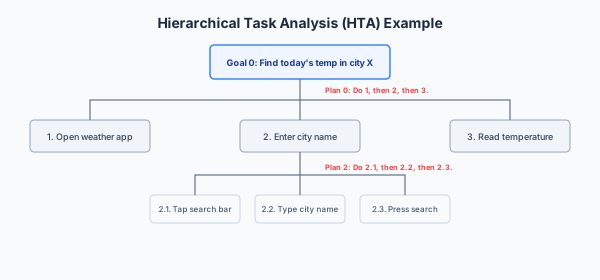
Worked Example: HTA for “Find Today’s Temperature in City X”
For a weather app that is not yet open (2020 Tripos style):
0. Find today's temperature in city X
  1. Open Weather App
     1.1 Locate app icon on home screen
     1.2 Tap to launch
  2. Enter city name
     2.1 Tap search/city field
     2.2 Type city name ("Cambridge")
     2.3 Submit search (tap search key or "Go")
  3. Read temperature from display

Plan 0: do 1, then 2, then 3.
Plan 2: do 2.1, then 2.2, then 2.3.
The numbering convention is important: sub-goals are numbered hierarchically (1, 2, 3 are children of 0; 1.1, 1.2 are children of 1). The plan attached to each non-leaf goal specifies the execution order.
Why Task Analysis Matters for Interaction Design
- It forces systematic thinking about what the user actually does, rather than what the designer assumes they do. Steps the designer considers trivial (locating the app icon) may be a genuine bottleneck for the user.
- It provides the action sequence for a Cognitive Walkthrough — the CW walks through a task analysis step by step, asking the four questions at each stage.
- It supports KLM/GOMS modelling — the task decomposition is the input to the timing model.
- It identifies opportunities for design improvement: if the task analysis shows 12 steps to achieve a common goal, the design may need simplification. If users consistently take a different path than the plan specifies, the interface may be signalling the wrong sequence.
Limitations of Task Analysis
Task analysis is a powerful tool, but it has significant limitations. When asked whether a limitation applies to a specific system, explicitly connect it: “this limitation applies because…”
| Limitation | Explanation |
|---|---|
| Assumes a fixed sequence | Ignores opportunistic, exploratory, or non-linear behaviour. Users do not always follow a plan — they explore, backtrack, and improvise. HTA is poor at modelling creative or open-ended work. |
| Ignores cognitive and emotional state | Does not capture cognitive load, frustration, anxiety, or motivation — all of which affect real-world performance. Two users following the same HTA may have radically different experiences. |
| Struggles with high variability | Difficult to apply where tasks are highly context-dependent or where there is no single “correct” path (e.g. creative collaboration, open-ended data exploration). |
| Misses tacit knowledge | Expert shortcuts and automatic behaviours that experts perform without conscious thought are easy to omit from the model — the expert does not even know they are doing them. |
| Poor at modelling errors | Does not naturally represent error states or recovery paths, which is where many real usability problems occur. A user who takes a wrong turn at step 2.2 has no modelled path back. |
| Cannot model novel or first-time tasks | Task analysis requires knowing the task in advance. For genuinely novel interaction (exploring a new device for the first time), there is no pre-existing task to analyse. |
Expected Learning
- Define HTA and describe its components: goals, sub-goals, operations, and plans.
- Decompose a described task into an HTA with at least three levels, writing numbered sub-goals and a plan at each non-leaf level.
- Explain how HTA supports Cognitive Walkthrough and KLM/GOMS.
- Name at least four limitations of task analysis, and for each, explain the specific circumstance in which it becomes a problem.
- For a given system, state whether task analysis is appropriate and justify with reference to the system’s characteristics (fixed-sequence vs exploratory, expert vs novel).
Past Paper Questions
Task analysis appears in: 2020 Q5 (task-analysis limitations; evaluating quantitative findings), 2017 Q5 (task model for GestureDriver interface; generic problem task analysis can identify). HTA is the foundation for Cognitive Walkthrough questions in 2021, 2022, and 2025.