Forest Representation: Union by Rank and Path Compression
Deep Forest Representation
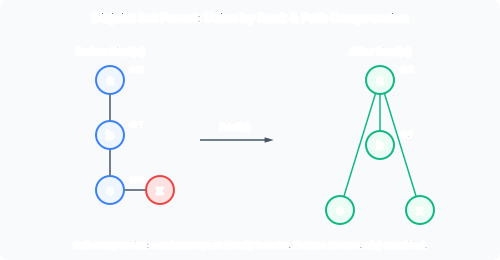
Each set is represented as a rooted tree where each node points to its parent. The root’s parent pointer is NIL (or points to itself). The root serves as the representative of the set.
MakeSet
MakeSet(x):
    x.parent = x    // or NIL, depending on convention
    x.rank = 0
Creates a singleton tree. .
Find (Chase)
Follow parent pointers from x up to the root:
Find(x):
    while x.parent != NIL:    // or != x
        x = x.parent
    return x
Without optimisations, worst-case if trees become long chains.
Union by Rank
When merging two trees, make the root with the smaller rank point to the root with the larger rank. If ranks are equal, choose one as the new root and increment its rank by 1.
Rank is an estimate (upper bound) on the height of the tree. It is NOT the same as height after path compression is applied; ranks never decrease.
Union(x, y):
    rx = Find(x)
    ry = Find(y)
    if rx == ry: return
    if rx.rank > ry.rank:
        ry.parent = rx
    else if rx.rank < ry.rank:
        rx.parent = ry
    else:                     // equal ranks
        ry.parent = rx
        rx.rank = rx.rank + 1
Union by rank guarantees that a tree of rank contains at least nodes (provable by induction: each rank increase to merges two trees of rank , each having nodes, yielding ). Therefore, rank is at most , and tree height (without compression) is .
Path Compression
During Find(x), after locating the root, revisit all nodes on the path and set their parent pointer directly to the root. This flattens the search path:
Find(x):
    if x.parent != x:
        x.parent = Find(x.parent)    // recursive compression
    return x.parent

// Iterative version:
Find(x):
    root = x
    while root.parent != root:
        root = root.parent
    // Second pass: compress
    while x != root:
        next = x.parent
        x.parent = root
        x = next
    return root
Path compression makes future Find operations on the same or descendant nodes much faster. The cost of the first traversal is amortised over future operations.
Worked Example
Start with 7 singletons, all rank 0:
MakeSet(1..7): each node parent = self, rank = 0| Operation | Action | Resulting Trees |
|---|---|---|
| Union(1,2) | ranks equal, 2→1, rank(1)=1 | 1(rank1)←2 |
| Union(3,4) | ranks equal, 4→3, rank(3)=1 | 3(rank1)←4 |
| Union(1,3) | rank(1)=1 > rank(3)=1? No, equal. 3→1, rank(1)=2 | 1(rank2)←2, 1←3(rank1)←4 |
| Union(5,6) | equal, 6→5, rank(5)=1 | 5(rank1)←6 |
| Union(5,7) | rank(5)=1 > rank(7)=0, 7→5 | 5(rank1)←6, 5←7 |
| Union(1,5) | rank(1)=2 > rank(5)=1, 5→1 | 1(rank2)←2,1←3←4,1←5←6,1←5←7 |
| Find(4) | path 4→3→1, compress: 4→1, 3→1 | 4 and 3 now point directly to 1 |
After Find(4) with compression:
      1(rank2)
    / | \  \
   2 3  4  5
          / \
         6   7
Combined Complexity
Using both union by rank and path compression, the amortised time per operation is , where is the inverse Ackermann function. For any practical (less than ), . Effectively constant time.
The proof of this bound is complex and uses a potential function based on partitioning ranks into levels; the full proof is beyond the Tripos scope but the result and the two heuristics are examinable.
Kruskal Complexity with Forest DS
With forest + union by rank + path compression:
MakeSet: calls,Find: calls,Union: calls,- Sorting:
Total: since sorting dominates.
Summary
| Heuristic | Guarantee | Alone | Combined |
|---|---|---|---|
| None | — | per Find worst | — |
| Union by rank | Tree height | per Find | |
| Path compression | Flattens search path | amortised | |
| Both | Inverse Ackermann | — | Essentially |
Key exam technique: When tracing Union/Find with compression, show the tree before and after each operation, and update ranks only on equal-rank Unions.