Collision Resolution: Chaining
How Chaining Works
In chaining, each slot of the hash table holds a pointer to a linked list (initially NIL). All pairs that hash to the same index are stored in the list at . There are multiple variants of chaining, differing in insertion policy and whether lists are sorted.
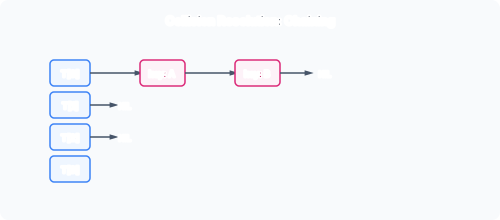
Variant 1: Unsorted List, Append at End (or Replace on Match)
- INSERT: hash to slot, walk the list. If key found, replace value. If not found, append a new cell to the end.
- SEARCH: hash to slot, walk the list until key is found or end is reached.
- DELETE: hash to slot, walk the list. If found, remove the cell. Otherwise, no-op.
Performance: Expected where is the load factor. Searching for a key that is present takes, on average, half the time of searching for an absent key (since present keys are found halfway down the list on average).
Variant 2: Sorted List
Keep each chain sorted by key order (not hash value order, since all keys in a chain have the same hash).
- INSERT: walk down the chain, insert when the next key is larger (or replace if equal).
- SEARCH: walk until key found or a larger key encountered (early termination for absent keys).
- DELETE: same search then removal.
Performance: Rebind and fresh insert take the same expected time (both stop at the sorted position). Requires keys to be comparable.
Variant 3: Push on Head, Tombstone Deletion
- INSERT: always push on the head, regardless of whether the key already exists.
- DELETE: push a tombstone entry on the head (key with NIL payload).
- SEARCH: walk until the first match for the key is found (ignoring tombstones, or returning NIL if the newest entry is a tombstone).
Performance: INSERT and DELETE are . SEARCH is where and are the total numbers of insert and delete calls — grows without bound. Best for read-only tables or where the table is rebuilt periodically.
Variant 4: Push on Head, Delete from List
- INSERT: push on the head.
- DELETE: walk the list and remove the first matching key.
- SEARCH: walk until first match.
Performance: INSERT: . SEARCH and DELETE: where is the number of insert calls. When a key is deleted, its previous binding “comes back to life,” giving stack-like semantics per key.
Load Factor and Performance
The load factor is the average chain length. Under the simple uniform hashing assumption (each key equally likely to hash to any slot), the expected chain length is , and:
- Unsuccessful search: traverse the entire chain, expected .
- Successful search: traverse roughly half the chain, expected .
If is bounded by a constant (by resizing when it exceeds a threshold, say ), all operations are expected.
Worst Case
All keys could hash to the same slot. Then each chain is length , and all operations become . This requires either a pathological hash function or an adversarial input. Universal hashing (see later note) protects against the latter.
Example
Hash table with slots, using . Insert 13, 27, 42, 8, 33:
Slot 0: [ ]
Slot 1: [ ]
Slot 2: 42 → 27
Slot 3: 33 → 13 → 8
Slot 4: [ ]
Search for 27: hash to 2, walk list: , found. Search for 50: hash to 0, walk: NIL, absent. Load factor .
Summary
| Variant | INSERT | SEARCH | DELETE | Notes |
|---|---|---|---|---|
| Unsorted, append | Rebind faster than fresh | |||
| Sorted | Needs comparable keys | |||
| Push on head, tombstone | SEARCH degrades | |||
| Push on head, remove | Stack semantics per key | |||
| Load factor | Expected if |