Equivalence of Red-Black and 2-3-4 Trees
The Isomorphism
Every 2-3-4 tree can be converted to a red-black tree, and every red-black tree can be converted back to a 2-3-4 tree. The two structures are isomorphic: operations on one translate directly to operations on the other, preserving correctness and asymptotic bounds.
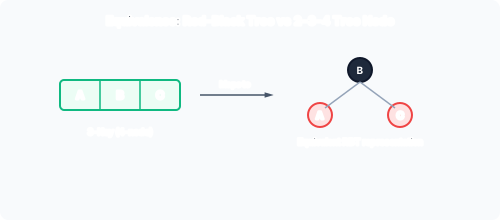
Mapping 2-3-4 Nodes to Red-Black Clusters
Each node type in a 2-3-4 tree maps to a small cluster of red-black nodes:
2-Node (1 key, 2 children) → Single Black Node
A 2-node has one key and two children. Its red-black representation is a single black node. The children of the black node are the representations of the 2-node’s subtrees.
3-Node (2 keys, 3 children) → Black + One Red Child
A 3-node has two keys, , and three children. There are two possible red-black representations (left- and right-handed isomers):
- Right-handed: black node with key , left red child with key . Children: leftmost subtree under red node, middle under black node’s left, rightmost under black node’s right.
- Left-handed: black node with key , right red child with key . Children arranged symmetrically.
4-Node (3 keys, 4 children) → Black + Two Red Children
A 4-node has three keys, , and four children. The red-black representation: black node with key , left red child with key , right red child with key . The four children map to the subtrees of the red and black nodes in order.
Black-Height as 2-3-4 Height
The black-height of a red-black tree equals the height of the corresponding 2-3-4 tree. This follows directly from the mapping: each level in the 2-3-4 tree contributes exactly one black node (the “anchor” of the cluster). Red nodes are “glued” to their black parent and do not increase the 2-3-4 tree height.
This explains why the red-black tree height is at most (or roughly ): in the worst case, every 2-3-4 node is a 3-node represented as a black node with a red child at the deepest level, doubling the path length compared to black-height.
Translating Operations
Insert
Inserting into a 2-3-4 tree: find leaf, insert key, split 4-nodes that overflow. Translating to red-black:
- Inserting a key into a 2-node (black node) → colour new node red. If parent is black, done. (Case 0)
- Inserting into a 3-node → new red node may create two consecutive reds. Resolving this is a rotation (Case 2 or 3).
- Inserting into a 4-node (black+two red children) → the 4-node is full. Splitting it in 2-3-4 terms corresponds to colour-flipping: the black parent becomes red, and both red children become black. This is exactly Case 1 of the RBT fix-up.
Splitting a 4-Node = Colour Flipping
When a 2-3-4 tree splits a 4-node, the middle key is promoted to the parent, and the node becomes two 2-nodes. In red-black terms:
- Before: black node with red children (left) and (right).
- After: becomes red (promoted into parent’s cluster), and become black (each becomes an independent 2-node).
This colour flip may create a red-red violation at the parent level, which is then resolved by Cases 2/3 or further Case 1 flips.
Merging in Deletion
When a 2-3-4 tree merges nodes during deletion (stealing the separator key from the parent), the corresponding red-black operation involves recolouring and rotations that redistribute “blackness” to fix double-black violations.
Why the Equivalence Matters
- Correctness: Proving RBT operations correct is done by showing they maintain the mapping to a valid 2-3-4 tree. The 2-3-4 tree’s perfect height balance guarantees the RBT’s logarithmic height.
- Intuition: The colour rules feel arbitrary until you see they encode 2-3-4 structure. “No two consecutive reds” means “no 2-3-4 node has more than 3 keys.” “Equal black-height” means “all 2-3-4 leaves are at the same depth.”
- Implementation: An RBT can be debugged by checking whether it maps to a valid 2-3-4 tree. This is a perfectly satisfactory correctness test.
Summary
| 2-3-4 Node | Red-Black Cluster | Keys |
|---|---|---|
| 2-node | Single black node | 1 |
| 3-node | Black + 1 red child | 2 |
| 4-node | Black + 2 red children | 3 |
| 2-3-4 height | RBT black-height = | |
| 4-node split | Colour flip (Case 1) | |
| Insert into 3-node | Rotation (Cases 2/3) | |
| RBT height bound | From 2-3-4 balance |