Rooted and Binary Trees
Tree Terminology
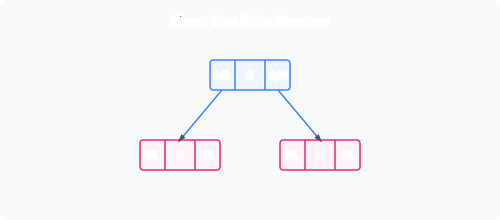
A rooted tree is a data structure with a single entry point (the root) and hierarchical parent-child relationships. Every node except the root has exactly one parent; the root has none.
| Term | Definition |
|---|---|
| Root | The unique topmost node with no parent |
| Parent | The node directly above a given node |
| Child | A node directly below a given node |
| Sibling | Nodes sharing the same parent |
| Leaf (external node) | A node with no children |
| Internal node | A node with at least one child |
| Depth of a node | Number of edges from root to that node (root has depth 0) |
| Height of a node | Number of edges on the longest path from that node to a leaf |
| Height of the tree | Height of the root |
| Level | Set of nodes at the same depth |
| Ancestor / descendant | Nodes on the path toward/away from the root |
Binary Trees
A binary tree is a rooted tree where each node has at most two children, designated as left child and right child. A child can be NIL (absent).
Types of binary trees:
- Full binary tree: every node has 0 or 2 children.
- Complete binary tree: all levels are completely filled except possibly the last, which is filled from left to right.
- Perfect binary tree: all leaves are at the same depth; every internal node has exactly 2 children. A perfect binary tree of height has nodes.
Height Bounds
For a binary tree with nodes:
- Minimum height: , achieved by a complete/perfect binary tree.
- Maximum height: , when every internal node has exactly one child (a degenerate tree, essentially a linked list).
Thus a balanced binary tree is one whose height is , giving logarithmic-time operations. An unbalanced tree degenerates to height.
Tree Traversals
Three fundamental depth-first traversals of a binary tree:
| Traversal | Order | Visits root |
|---|---|---|
| Preorder | Root, then left subtree, then right subtree | First |
| Inorder | Left subtree, then root, then right subtree | Middle |
| Postorder | Left subtree, then right subtree, then root | Last |
Example tree with root , left child , right child (where has left child , right child ):
- Preorder:
- Inorder:
- Postorder:
Inorder traversal of a binary search tree visits keys in sorted order.
Array Representation of Binary Trees
Store a complete binary tree in an array A[1..n]:
| Node | Array index |
|---|---|
| Root | A[1] |
| Parent of | A[floor(i/2)] |
| Left child of | A[2i] |
| Right child of | A[2i + 1] |
This is the representation used for heaps. No explicit pointers are needed; the tree structure is encoded in the indices. The condition for a child to exist is (or ).
Pointer-Based Representation
Each node is an object with fields:
class TreeNode:
    key       # data
    left      # pointer to left child (or NIL)
    right     # pointer to right child (or NIL)
    parent    # pointer to parent (or NIL), optional
Parent pointers are required for algorithms like PREDECESSOR and SUCCESSOR in BSTs, and for efficient traversal without an explicit stack.
Trees with Unbounded Branching
When nodes can have arbitrarily many children, a linked list of children is used rather than fixed left/right pointers. An alternative is the left-child, right-sibling representation: each node has a pointer to its first child and a pointer to its next sibling. This encodes any tree as a binary tree.
Binary Search Trees (Preview)
A BST is a binary tree satisfying the BST property: for every node , all keys in the left subtree are strictly less than , and all keys in the right subtree are strictly greater. BSTs support SEARCH, INSERT, DELETE, MINIMUM, MAXIMUM, PREDECESSOR, and SUCCESSOR in time where is the tree height. With balanced trees, ; with degenerate trees, .
Summary
| Property | Value |
|---|---|
| Min height (balanced) | |
| Max height (degenerate) | |
| Perfect tree size | nodes |
| Array rep.: left child | |
| Array rep.: right child | |
| Preorder | Root → left → right |
| Inorder | Left → root → right (sorted for BSTs) |
| Postorder | Left → right → root |
| BST property | Left subtree root right subtree |