Queues
Abstract Data Type
A queue is a first-in, first-out (FIFO) collection. Elements are added at the rear and removed from the front. Operations:
| Operation | Description |
|---|---|
ENQUEUE(Q, x) | Add element to the rear of the queue |
DEQUEUE(Q) | Remove and return the front element |
FRONT(Q) | Return the front element without removing it |
IS-EMPTY(Q) | Return true iff queue contains no elements |
Circular Array Implementation
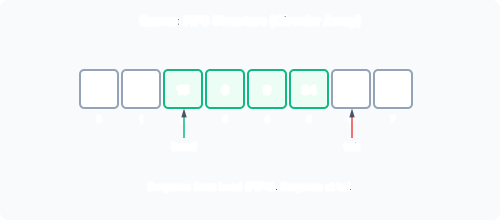
A fixed-capacity array Q[1..n] with two indices: head (front of queue) and tail (first free slot after the rear). Both wrap around modulo using an inc helper:
inc(x): return (x == Q.length) ? 1 : x + 1- Initially:
head = tail = 1(empty queue). - Enqueue: store at
Q[tail], thentail = inc(tail). - Dequeue: retrieve
Q[head], thenhead = inc(head). - Empty:
head == tail. - Full:
inc(tail) == head(or equivalentlyhead == tail + 1modulo ).
All operations are . At most items can be stored (one slot is sacrificed to distinguish full from empty, since both would have head == tail).
Linked List Implementation
Maintain head (front) and tail (rear) pointers. Enqueue adds at the tail, dequeue removes from the head. Both operations are . No capacity limit.
ENQUEUE(Q, x):
    node = new Node(value=x, next=NIL)
    if Q.tail == NIL:
        Q.head = Q.tail = node
    else:
        Q.tail.next = node
        Q.tail = node

DEQUEUE(Q):
    if Q.head == NIL: error "empty"
    x = Q.head.value
    Q.head = Q.head.next
    if Q.head == NIL: Q.tail = NIL
    return x
Circular Buffer Variant
The circular array queue is also known as a circular buffer. It is widely used in operating systems for kernel pipes and I/O buffering. It avoids the allocation/deallocation overhead of linked lists and provides cache-friendly linear memory access.
Deque (Double-Ended Queue)
A deque supports insertion and deletion at both ends: PUSH-FRONT, PUSH-BACK, POP-FRONT, POP-BACK. It can be implemented with a doubly linked list or a circular array, all operations . A deque generalises both stacks and queues.
Applications
| Application | How the queue is used |
|---|---|
| Task scheduling | FIFO scheduling: tasks processed in arrival order |
| Breadth-first search | Discovered vertices are enqueued; processed in FIFO order |
| Print queues | Jobs printed in submission order |
| Buffering / I/O | Data buffered between producer and consumer (circular buffer) |
| Message passing | Messages delivered in order between threads/processes |
Comparison: Stack vs. Queue
| Aspect | Stack | Queue |
|---|---|---|
| Order | LIFO | FIFO |
| Insert called | Push | Enqueue |
| Remove called | Pop | Dequeue |
| Array implementation | One index (top) | Two indices (head, tail) with wrap |
| Full detection | top == n | inc(tail) == head |
| Applications | Recursion, undo, parsing | Scheduling, BFS, buffering |
Summary
| Property | Circular Array | Linked List |
|---|---|---|
| ENQUEUE | ||
| DEQUEUE | ||
| FRONT | ||
| IS-EMPTY | ||
| Max capacity | items | Unbounded |
| Space | pre-allocated | Per-element |
| Principle | FIFO |